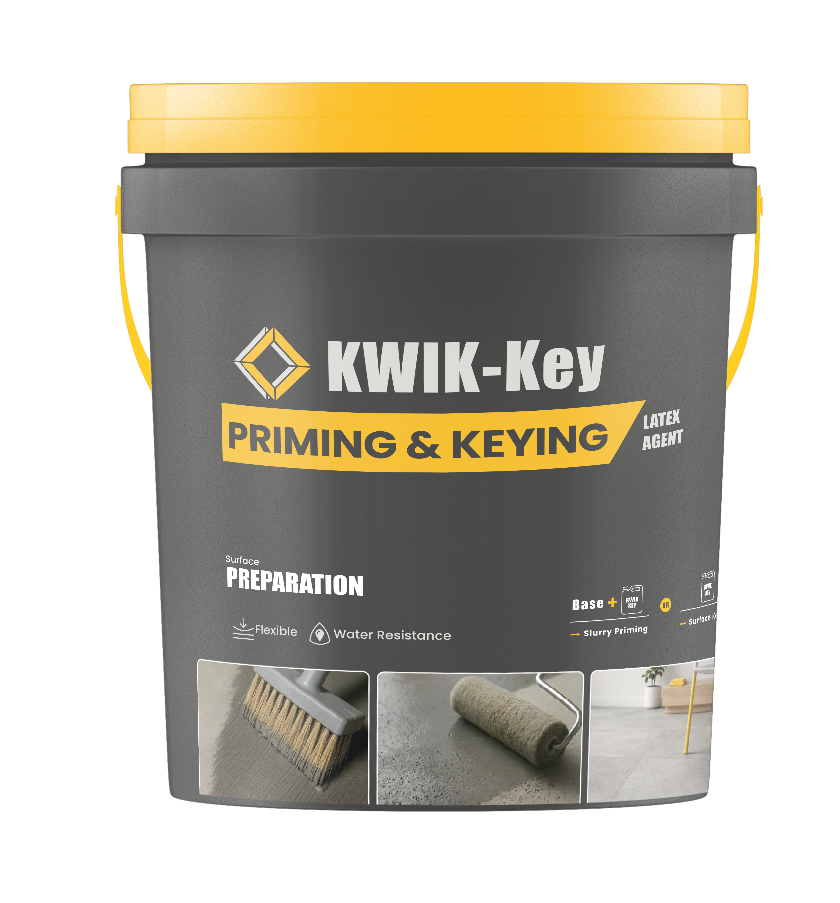
How to apply
Kwik-Key Primer & Bonding Slurry
- Slurry
- Primer
- Interior & Exterior
How to correctly apply KWIK-Key for improved adhesion and surface preparation. This guide outlines essential priming and slurry application methods to ensure reliable bonding of tile adhesives, screeds, and cementitious products to both porous and dense substrates.
ESSENTIAL APPLICATION REQUIREMENTS
Installation Conditions
The following requirements apply to all KWIK-Key applications and must be followed to ensure correct adhesion and performance.
- Substrates must be structurally sound, clean, and properly prepared before priming or slurry application.
- All surfaces must be free of dust, grease, curing compounds, laitance, wax, oil, or loose material.
- KWIK-Key must be used either be used neat or diluted as a primer or mixed as a slurry, depending on substrate type and condition.
- Ensure the substrate is dry and stable before application. Standing water or excessive moisture must be removed.
- Apply KWIK-Key evenly and continuously to avoid patchy absorption or inconsistent bonding.
- Allow the primer or slurry to dry or become tacky as required before proceeding with tiling, screeding, or adhesive application.
- Only prepare as much slurry as can be used within the working time. Do not re-temper once the slurry begins to stiffen.
- Always follow the recommended dilution or mix ratios for the specific application.
For surface-specific priming and slurry methods, refer to the detailed guides below.
What KWIK-Key Is Used For
It is used before tiling, screeding, or adhesive application to promote mechanical and chemical bonding between the substrate and cement-based products
Application Methods
KWIK-Key can be used in two primary ways, depending on the surface condition:
Primer Application
- Used on absorbent or lightly porous substrates
- Regulates suction and improves adhesion
- Applied by brush, roller, or broom
Slurry Application
- Used on dense, sealed, smooth, or tile-on-tile surfaces
- Creates a mechanical key for adhesives or screeds
- Applied with a brush or trowel as a bonding coat
Coverage (20KG Bag)
(Coverage depends on trowel size, conditions & application.)
- Priming application:
- 1L Water to 1L KWIK-key: ±5–8 m² • Neat application: ±3–5 m²
- Slurry application:
-
2L KWIK-key to 4kg KWIKbase: ±3 m² • Neat application: ±3–5 m²
-
KWIK-Key mixing ratios & use cases
KWIK-Key is a bond-enhancing primer and slurry liquid used to improve adhesion on dense, smooth, sealed, or non-porous substrates prior to tiling, screeding, or applying cement-based adhesives. It is not an adhesive on its own, it prepares the surface to ensure reliable bonding of the product that follows.
Primer Application (Porous / Absorbent Surfaces)
Typical ratio:
- KWIK-Key : Water = 1 : 1
- (Can be applied neat on very porous substrates if required)
Use when:
- Substrates are absorbent and drawing moisture too quickly
- Plaster, screeds, concrete, or cement boards
- Regulating suction before tiling or screeding
Purpose:
- Controls suction
- Improves adhesive wetting and open time
- Reduces premature drying of cement-based products
How to apply:
- Apply KWIK-Key evenly using a block brush, broom, roller, or soft brush
- Work the liquid well into the surface to ensure full penetration
- Avoid puddling — the surface should be dampened, not flooded
- Allow the primer coat to become tacky, not fully dry, before proceeding
Second coat (if required):
- On highly absorbent substrates, a second coat may be applied
- Apply the second coat perpendicular to the first to ensure uniform coverage
- Proceed with tiling, screeding, or adhesive application while the surface remains tacky
Additional notes:
- On highly absorbent substrates, a second coat may be applied if the first coat is absorbed too quickly
- Tiling, screeding, or adhesive application should commence while the surface remains tacky
Slurry / Bonding Coat (Dense or Non-Porous Surfaces)
Typical ratio:
- 1 Part KWIK-Key + 2 Parts KWIKbase
- Mixed to a smooth, paintable slurry consistency
Use when:
- Tile-on-tile installations
- Painted or sealed concrete
- Power-floated or smooth screeds
- Waterproofed surfaces
- Dense cement boards or precast elements
Purpose:
- Creates a mechanical and chemical bonding layer
- Allows cement-based products to key into smooth surfaces
- Prevents debonding and shear failure
How to apply:
- Mix KWIK-Key with cement to a smooth, paintable slurry
- Apply using a block brush, stiff brush, or steel trowel, depending on surface texture
- Ensure continuous, full coverage with no missed areas
- Avoid excessive build-up or ridging
Second coat (if required):
- Where necessary, apply an additional coat perpendicular to the first
- Always apply subsequent layers while the slurry remains tacky
Important:
- Apply tiles, screed, or adhesive into the slurry while it is still tacky
- If the slurry dries, reapply a fresh coat before continuing
Important Application Notes
- KWIK-Key is not a waterproofing product
- Must always be used in accordance with the substrate type and application method
- Tiling, screeding, or adhesive application should proceed while the slurry is tacky or within the recommended open window
Curing and Cleaning
KWIK-Key is a polymer bonding agent designed to promote adhesion between substrates and cement-based products. It does not cure independently and must be used in conjunction with the product it is bonding.
Curing Guidelines
- KWIK-Key cures as part of the cement-based system it is used with
- Follow the curing and drying requirements of the tile adhesive, screed, or grout being applied
- Do not allow the bonding coat to dry completely before applying the next layer unless specified
- Apply tiling, screeding, or adhesive while the slurry or primer coat is tacky
Key Installer Reminder
KWIK-Key enhances bond strength and performance but does not replace correct curing practices of the primary product. Always refer to the application instructions of the adhesive, screed, or grout being used.
Cleaning Notes
- Clean tools and containers with clean water immediately after use
- Dried KWIK-Key residue must be removed mechanically
- Avoid contamination of adjacent finished surfaces